
A Ground-Level Look at Singapore Fastest Growing Sectors and Why 2026 Feels Different
A few years ago, when Malaysians talked about Singapore, it was mostly about jobs in banking, oil trading, maybe logistics. Stable sectors. Safe sectors. Now the conversations sound different. People are mentioning AI chips. Climate tech. Family offices. Biotech labs. Venture capital. Even IPO pipelines. You start hearing phrases like “fastest growing industries in Singapore 2026” in casual kopi chats. Not just in boardrooms. So what actually changed? Let’s break down the Singapore fastest growing sectors in 2026 — not from a textbook angle, but from what’s visibly happening on the ground.
- 1. AI & Advanced Electronics – The Manufacturing Comeback
- 2. Green Economy & Energy Transition – Not Just a Buzzword
- 3. Fintech, Wealth & Capital Markets – Where Money Moves Faster
- 4. Biomedical & Health Innovation – Quiet but Powerful
- 5. Digital Trade & Regional HQ Services – The Invisible Engine
- Why 2026 Feels Like a Transition Year
1. AI & Advanced Electronics – The Manufacturing Comeback

For a long time, many assumed manufacturing had moved elsewhere in Asia. But if you look at recent production data, electronics has been one of the top performing industries Singapore relies on for growth. Walk through industrial parks in Jurong or Tampines and you won’t see low-cost assembly lines. You’ll see semiconductor fabs, precision engineering facilities, and AI-related hardware operations.
The global AI wave — from data centers to autonomous systems — depends heavily on advanced chips. Singapore plays a serious role in this supply chain. This is why electronics is repeatedly cited among the Singapore economic growth sectors. It’s not just volume. It’s high-value manufacturing.
Behind the scenes, multinational chip companies continue expanding capacity here. When global demand for AI infrastructure rises, Singapore benefits almost quietly. For those looking at best sectors to invest in Singapore, advanced manufacturing keeps coming up — not flashy, but steady and deeply integrated into global tech.
2. Green Economy & Energy Transition – Not Just a Buzzword
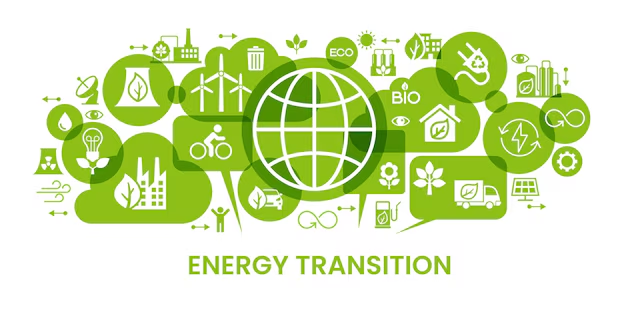
If you attend any regional business event lately, someone will mention sustainability within the first 15 minutes. In Singapore, this isn’t just branding. Carbon services, renewable energy trading, sustainable finance frameworks — these are real emerging industries in Singapore. The government’s push toward a low-carbon economy has accelerated green innovation.
But what does that mean practically? It means solar developers using Singapore as a regional HQ and it means carbon credit exchanges setting up operations. It means banks building sustainable finance teams. Energy transition projects across Southeast Asia often route structuring, financing, and advisory work through Singapore. That ecosystem effect is what makes green tech one of the high growth sectors Singapore is nurturing.
You can see it in hiring trends. ESG roles didn’t exist widely ten years ago. Now they’re common. It’s not overnight growth. It’s gradual, policy-backed expansion.
3. Fintech, Wealth & Capital Markets – Where Money Moves Faster

If there’s one area people consistently associate with Singapore, it’s finance. But the story in 2026 feels different from traditional banking dominance. Family offices have grown significantly over recent years. Wealth management services expanded alongside global capital flows into Asia. Fintech startups — payments, digital assets infrastructure, cross-border platforms — continue shaping the Singapore startup ecosystem growth narrative.
Look at venture capital trends Singapore has experienced: funding cycles fluctuate, yes, but Singapore remains a central hub for Southeast Asia deals. It’s also one of the Singapore IPO sectors to watch. The SGX may not match US exchanges in scale, but listings tied to tech, REITs, and growth companies continue to appear.
For entrepreneurs across ASEAN, setting up in Singapore still offers access to capital, regulatory clarity, and global banking infrastructure. That combination keeps financial services among Singapore future industries with strong momentum.
4. Biomedical & Health Innovation – Quiet but Powerful

During the pandemic years, attention turned to healthcare systems worldwide. Singapore already had a solid biomedical base before that — pharmaceutical manufacturing, research institutes, clinical trials infrastructure. Today, biotech research, cell therapy work, and advanced pharma production continue expanding.
Drive around Biopolis and you’ll see research facilities that house global pharma names. The biomedical sciences sector contributes significantly to manufacturing output. Why is this one of the Singapore fastest growing sectors? Because healthcare demand doesn’t disappear. Ageing populations across Asia create long-term needs. Singapore positions itself as both an R&D hub and a production base. It’s not a loud industry. But it’s resilient. And for those tracking Singapore business opportunity 2026 discussions, life sciences repeatedly enters the conversation.
5. Digital Trade & Regional HQ Services – The Invisible Engine

Here’s something less talked about but extremely important. Many multinational companies use Singapore as their Asia-Pacific headquarters. From tech giants to commodity traders, regional decision-making often happens here. With digital trade agreements expanding and cross-border e-commerce growing, Singapore has strengthened its role as a digital trade node.
It’s not about factories. It’s about coordination. Supply chains across ASEAN. Data flows. Legal structuring. Regional treasury operations. When people analyze Singapore high ROI industries, they often overlook corporate services and digital trade facilitation. But this is where consistent value is created.
The country’s regulatory framework, tax environment, and connectivity make it efficient for companies to manage Southeast Asia operations from one place. This ecosystem effect reinforces why Singapore fastest growing sectors are interconnected rather than isolated.
Why 2026 Feels Like a Transition Year
What’s interesting is not just which sectors are growing — it’s how they overlap. AI needs advanced chips. Chips need precision engineering. Engineering requires skilled talent. Talent flows into finance. Finance funds green projects. Green projects rely on regional coordination. It’s a loop. That’s why when people search for fastest growing industries in Singapore 2026, the answer isn’t a single dramatic industry. It’s a cluster of interconnected systems.
From manufacturing to fintech, from biotech labs to venture capital trends Singapore investors track — the momentum feels layered, not linear. For Malaysians watching from across the Causeway, this shift matters. Not because everyone needs to relocate. But because regional business gravity is adjusting. And when gravity shifts, opportunities tend to follow quietly. Singapore fastest growing sectors in 2026 are less about hype and more about structural positioning. That difference is what makes this phase feel different from previous cycles.