

Singapore ranked fourth globally in startup ecosystem standings in 2025, up from 16th place in 2020, according to a joint report published in July 2026 by global management consultancy Arthur D. Little and the Singapore Economic Development Board (EDB). The report, titled Singapore As A Global Platform For Corporate Venturing, identifies three sectors — semiconductors, artificial intelligence and healthcare — as the primary areas where corporations are actively co-developing, piloting and scaling new ventures from a Singapore base. Each sector is examined below using the same evidence fields: infrastructure, active corporate participants and measurable output.
- What Is Driving Singapore’s Rise to Fourth Place
- Ranked: Singapore’s Three Leading Corporate Venturing Sectors
- 1. Semiconductors — Deepest Industrial Infrastructure, Proven Deployment at Scale
- 2. Artificial Intelligence and the Digital Economy — Highest Corporate Concentration, Multiple Active Pilots
- 3. Healthcare and Biomedical Sciences — Largest Manufacturing Base, Structured Incubation Track Record
- Sector Comparison at a Glance
- Why These Three Sectors Are Ranked Ahead of Others
The selection basis for this ranking is the depth of verifiable corporate venturing activity — defined as structured co-development, piloting or incubation between established corporations and startups — within each sector, as reported in the Arthur D. Little and EDB source document. Sectors are ordered by the breadth of supporting infrastructure and the volume of specific examples provided in that document.
What Is Driving Singapore’s Rise to Fourth Place
The foundation underpinning all three sectors is Singapore’s Research, Innovation and Enterprise (RIE) 2030 framework. Public investment under RIE 2030 was set at S$28b for the 2021–2025 period and is projected to increase to approximately S$37b for 2026–2030, with an explicit shift toward commercialisation — helping research institutions convert outputs into startups capable of working alongside corporations.
The report notes three structural advantages that make Singapore attractive for corporate venturing: faster collaboration timelines with startups, lower regulatory uncertainty, and reduced complexity when accessing the broader Asia-Pacific region. Singapore is also identified in the report as the most popular regional headquarters destination in Asia.
Ranked: Singapore’s Three Leading Corporate Venturing Sectors
1. Semiconductors — Deepest Industrial Infrastructure, Proven Deployment at Scale
Why it ranks first: The semiconductor sector offers the most complete chain of infrastructure in the supplied report — from fabrication facilities and materials research to applied engineering and university-industry collaboration — and provides the most fully documented corporate venturing case study.
Infrastructure: Singapore’s semiconductor ecosystem spans fabrication, equipment manufacturing and applied research. A*STAR’s Institute of Microelectronics supports advanced packaging and chiplet architectures. A*STAR’s Institute of Materials Research and Engineering focuses on materials science and nanofabrication. Advanced Micro Foundry, now part of GlobalFoundries, provides speciality fabrication and prototyping access.
Key advantage for corporate venturing: The report specifically highlights proximity to operating fabrication facilities. Startups can test solutions against real yield, reliability and throughput constraints — rather than simulated environments — shortening validation cycles and building industrial credibility that matters to large corporate partners.
Active corporate participant — GlobalFoundries and SixSense: The report cites GlobalFoundries as a documented example of corporate venturing in the sector. The company faced a labour-intensive, error-prone wafer defect classification process and co-developed a machine learning solution with Singapore-founded startup SixSense. The solution combined defect image recognition with wafer-map analysis.
| Metric | Outcome (as reported) |
|---|---|
| Defect classification automation rate | More than 90% |
| Accuracy improvement | Approximately 50% |
| Tool utilisation improvement | Approximately 15% |
| Scale | Deployed from Singapore to GlobalFoundries’ global operations |
Source: Arthur D. Little and EDB report, as reported by Singapore Business Review, published 23 July 2026.
2. Artificial Intelligence and the Digital Economy — Highest Corporate Concentration, Multiple Active Pilots
Why it ranks second: The AI sector has attracted the largest number of named multinational participants and has the most active pilot programmes documented in the report, though the venturing examples span a broader range of industries rather than a single tightly integrated supply chain.
Policy infrastructure: In 2026, the Singapore government committed more than S$1b under the National AI Research and Development Plan to strengthen foundational and applied AI capabilities and to build a pipeline of deployment-ready talent. The report notes that Singapore’s AI strategy is focused on deployment of solutions rather than development of large frontier models.
Corporate presence: More than 60 companies have established AI centres of excellence in Singapore, according to the report. Named participants include:
- OpenAI — established its Asia-Pacific base in Singapore in 2024
- Microsoft — launched its first Southeast Asia AI research lab (year reported as “last year” relative to the July 2026 publication date, indicating 2025)
- AWS — established an Asia-Pacific Innovation Hub focused on AI and cloud adoption
Active venturing pilots:
- Changi Airport Group and UISEE: Changi Airport Group partnered with autonomous driving startup UISEE to deploy driverless baggage-handling tractors operating between terminals and aircraft stands.
- ComfortDelGro and Pony.ai: Piloting driverless passenger shuttle buses in Punggol, a residential township with more than 200,000 residents.
- Grab and WeRide: Also piloting driverless passenger shuttle buses in the same Punggol location.
The report does not provide quantified outcome metrics for the autonomous vehicle pilots equivalent to those available for the GlobalFoundries case.
3. Healthcare and Biomedical Sciences — Largest Manufacturing Base, Structured Incubation Track Record
Why it ranks third: The healthcare sector leads on manufacturing scale and regulatory standing, and has a documented incubation programme with capital-raising results. However, the report provides fewer active co-development case studies between corporations and startups compared with the semiconductor and AI sectors.
Scale of corporate presence (as at the report’s publication date):
- More than 80 regional headquarters for global pharmaceutical and biotechnology companies
- 60 manufacturing plants
- 30 research and development centres
- Biomedical manufacturing output: S$38.1b in 2023
- Output growth: 16.3% from 2024 to 2025
Regulatory standing: Singapore’s Health Sciences Authority holds WHO Maturity Level 4 status, reflecting internationally recognised regulatory standards. The report presents this as a structural advantage that reduces approval risk for corporations venturing in the sector.
Research infrastructure: Duke-NUS Medical School and A*STAR’s Biomedical Research Council support translational research across therapeutics, diagnostics, digital health and precision medicine, operating in close alignment with hospital systems.
Active corporate participant — Johnson & Johnson JLABS Singapore: Launched in 2023, JLABS Singapore is cited as the primary structured corporate venturing example in the healthcare sector. As of December 2025, it had supported 50 companies. Those companies had collectively raised S$1.55b since joining the programme.
Sector Comparison at a Glance
| Sector | Key Infrastructure Bodies | Named Corporate Participants | Measurable Output (as reported) |
|---|---|---|---|
| Semiconductors | A*STAR IME, A*STAR IMRE, Advanced Micro Foundry / GlobalFoundries | GlobalFoundries, SixSense | >90% defect automation; ~50% accuracy gain; ~15% tool utilisation gain; scaled globally |
| AI and Digital Economy | National AI R&D Plan (S$1b+, 2026); 60+ AI centres of excellence | OpenAI, Microsoft, AWS, UISEE, Pony.ai, WeRide, Changi Airport Group, ComfortDelGro, Grab | Pilot deployments active; outcome metrics not stated in the supplied sources |
| Healthcare and Biomedical Sciences | Duke-NUS, A*STAR Biomedical Research Council, HSA (WHO Level 4) | Johnson & Johnson (JLABS Singapore) | 50 companies supported; S$1.55b raised collectively as of December 2025 |
Why These Three Sectors Are Ranked Ahead of Others
The Arthur D. Little and EDB report does not score or rank sectors against one another. This site’s ordering reflects three criteria applied consistently across the supplied evidence: the completeness of documented infrastructure, the number of named corporate venturing participants and the availability of specific, quantified outcomes.
Semiconductors places first because it is the only sector where a single end-to-end venturing case — from problem identification through co-development to global deployment — is documented with numerical results. AI and the digital economy ranks second on the strength of the largest named corporate presence and the greatest number of active pilots, even where outcome data is not yet available. Healthcare ranks third because the JLABS capital-raising figure and the sector’s manufacturing scale are concrete, but the number of documented co-development cases between corporations and startups is smaller relative to the other two sectors.
All three sectors share the same enabling condition: Singapore’s RIE 2030 public investment framework, which is designed to move research outputs toward commercially deployable products and to create the startup pipeline that corporate venturing programmes require. With funding rising from S$28b (2021–2025) to approximately S$37b (2026–2030), the structural conditions supporting corporate venturing across all three sectors are set to expand, not contract.
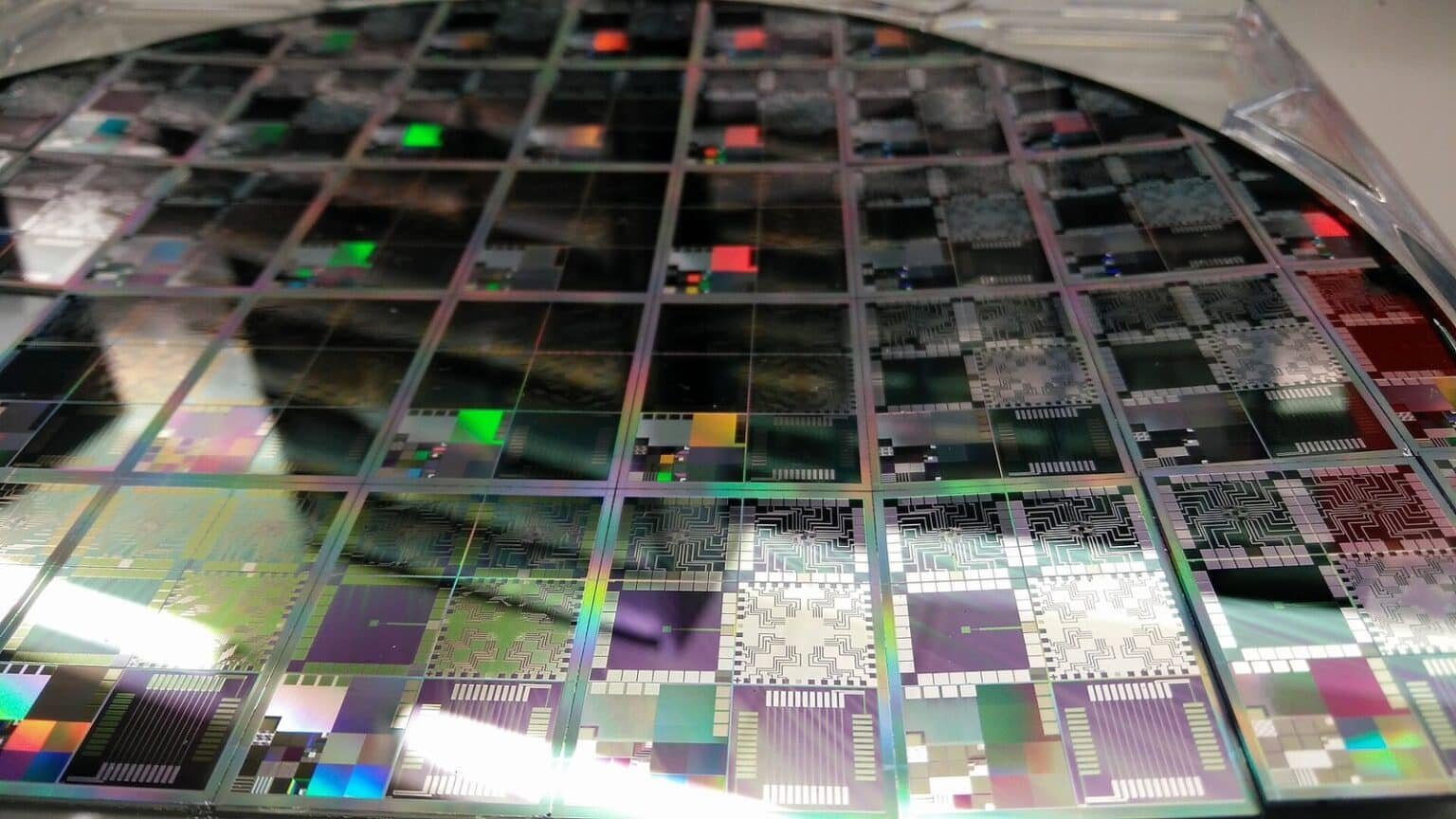
Illustrative photo: Semiconductor Wafer of Microelectronics.jpg by DrHughManning / Wikimedia Commons. CC BY-SA 4.0. Resized for display.